
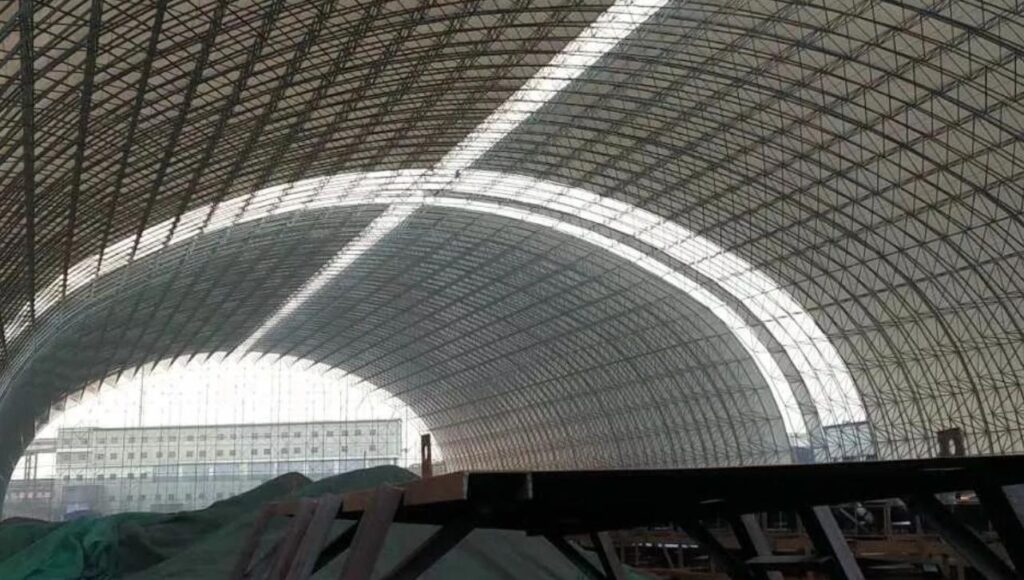
Recently, a client from Indonesia approached us to design and build a large-scale tensile membrane structure for coal storage at a mining site. This project spans several thousand square meters, requiring not only structural stability but also excellent protection from wind, rain, and dust. As the demand for efficient and environmentally responsible coal storage solutions grows across the energy and mining sectors, it’s crucial to understand what makes a Coal Storage Building effective. In today’s article, I’d like to share key insights on coal storage structures—from the difference between membrane and traditional steel grid designs, to what factors you should consider before choosing a solution, and why companies like Jieol are leading the way in this field.
Why Do We Need a Coal Storage Building?
Coal yards are known for generating significant amounts of dust, which not only worsens local air quality but also poses serious environmental and health risks. Open-air storage makes it difficult to control these emissions, especially during dry or windy weather. As environmental regulations tighten and ESG (Environmental, Social, and Governance) standards become more critical across the energy sector, enclosed coal storage has become an essential solution.
A well-designed Coal Storage Building offers multiple advantages. First, it protects coal from wind and rain, preventing moisture absorption that leads to combustion risk, reduced calorific value, and material loss. By eliminating water contamination and dust dispersal, it helps operators reduce environmental pollution and improve site cleanliness.
Second, an enclosed structure enables better inventory management and operational safety. It allows for easier access control, more accurate volume calculations, and safer movement of loaders or conveyor systems within a sheltered environment.
Lastly, local governments in countries like Indonesia and China are increasingly pushing for coal yard upgrades as part of industry rectification efforts. Closed coal storage is often mandatory in new permits and environmental assessments.
In short, building a coal storage facility is no longer an optional investment—it’s a necessary step toward sustainable, compliant, and efficient operations in the coal and energy sectors.
Tensile Membrane Coal Sheds vs. Traditional Steel Grid Structures
When it comes to coal storage, selecting the right structural solution is critical for environmental protection, operational safety, and cost control. Traditional steel grid coal sheds are widely used but come with limitations. Their heavy structure, longer construction period, and poor airtightness make them less ideal for large-scale, modern coal yards. For example, completing a steel coal shed spanning over 10,000 square meters can take 6 to 8 months, whereas a tensile membrane structure of the same scale can be fully installed within just 2 months, thanks to its modular components and streamlined construction process.
Tensile membrane sheds also offer clear advantages in environmental performance. The membrane provides a sealed, positive-pressure environment that prevents coal dust from escaping and outside dust from entering. This significantly improves air quality around the coal yard and meets stricter environmental regulations. The membrane’s translucent nature reduces the need for artificial lighting during the day and supports energy-saving lighting design at night.
From a cost perspective, while traditional steel structures may appear more economical at the outset, they typically require more frequent maintenance, especially in corrosive environments. Tensile membrane structures are highly durable, low-maintenance, and have a lower lifecycle cost. Additionally, they offer better thermal performance, more flexible design aesthetics, and stronger resilience against extreme weather—such as typhoons, earthquakes, and heavy snow.
In summary, tensile membrane coal sheds provide a faster, cleaner, safer, and more sustainable alternative to conventional steel grid coal storage solutions.
Key Considerations When Choosing a Coal Storage Building Solution
Choosing the right coal storage building involves more than just picking a structure—it’s a strategic decision that affects environmental compliance, operational efficiency, and long-term cost control. Here are the key factors to evaluate before starting any coal storage project.
First, site conditions play a critical role. The size of the coal yard, terrain elevation, local wind loads, and seismic activity must all be assessed to ensure the structure’s stability. For example, in coastal or mountainous regions, the design must account for typhoon resistance or earthquake resilience. A precise topographic survey helps guide foundation planning and frame anchoring.
Second, the selection of materials is vital for both durability and performance. Most tensile structures use high-strength PVC or PVDF membranes paired with galvanized or painted steel frames. These materials resist corrosion caused by coal dust, humidity, and chemicals, ensuring longevity with minimal maintenance.
Span and clearance requirements are another major consideration. Coal storage often requires large internal spaces to accommodate dump trucks, conveyors, and stacker-reclaimers. Tensile structures can achieve spans over 100 meters without internal columns, offering maximum maneuverability for heavy machinery.
In terms of operations, fire safety, ventilation, and dust suppression systems must be integrated from the design stage. Positive air pressure, natural ventilation, and misting systems help control air quality and reduce explosion risk in enclosed spaces.
Installation time and total project cost also weigh heavily on decision-making. Tensile membrane structures offer a significant advantage here—they can be fabricated and installed in as little as two months, at a cost 20–30% lower than traditional steel grid options.
Case Study: Indonesia Mining Site, 2024
In 2024, a client from Indonesia commissioned Jieol to design a 6,000 m² tensile membrane coal storage facility. The site was located in a high-humidity area with frequent rainfall and strong wind. Jieol proposed a fully enclosed PVDF membrane structure with integrated ventilation and dust control. The project was completed in just 58 days and reduced the client’s coal loss and dust complaints by over 70%. The design also allowed for 12-meter-high clearance to accommodate loader trucks and conveyors seamlessly.
Why Jieol Is the Ideal Contractor for Coal Storage Buildings
Jieol stands out as a trusted and experienced partner in the tensile membrane industry. With a proven track record of delivering large-span membrane structures across mining, energy, and heavy industrial sectors, Jieol has the expertise to handle complex engineering challenges with speed and precision.
From conceptual design to fabrication and on-site installation, Jieol offers an integrated, end-to-end service. This streamlines project coordination, reduces lead times, and ensures consistent quality throughout every phase. Jieol uses only premium-grade materials such as high-performance PVC and PVDF membranes, paired with corrosion-resistant steel frames. Coupled with advanced tensioning technology, these structures provide excellent durability and weather resistance.
Having worked with clients across Asia, Jieol understands the operational demands and regulatory requirements of the coal and energy industries. What sets Jieol further apart is its robust after-sales support, including routine inspections, membrane maintenance, and structural upgrades—ensuring that each project delivers long-term performance and reliability.
Check Our Other Realistic Case Studies:
| Project Name | Description | Details |
|---|---|---|
| Tensile Structure for Supermarket Lagos, Nigeria | Custom tensile canopy for a major supermarket in Lagos, providing sun protection and a recognizable architectural element. | 📅 June 2025 📐 ~1,200㎡ |
| Outdoor Sports Court Canopy Guangdong, China | Weather-resistant tensile roof for a public sports court, combining functionality with modern aesthetics. | 📅 June 2025 🏟️ Recreation |
| Tensile Walkway Canopy Da Nang, Vietnam | Continuous tensile walkway canopy built for pedestrian protection and urban beautification in coastal Da Nang. | 📅 June 2025 🚶 Walkway Use |
| Camping Park Shelter Chiang Mai, Thailand | Elegant 900㎡ tensile canopy in a camping park, blending with nature while providing tourist-friendly weather protection. | 📅 June 2025 📐 900㎡ |
| Stadium Tensile Roof Surabaya, Indonesia | Large-span tensile roof (3,280㎡) for a multi-purpose stadium, offering year-round protection with open-air design. | 📅 June 2025 📐 3,280㎡ |




 English
  Spanish
  French
  Russian
  Indonesian
  Thai
Thai  Arabic
  German